

- 11 views
If you work with hooded eyes, monolids or lashes that grow straight or downwards, you know the feeling: you place a beautiful C or D curl and, when the client opens her eyes, it disappears under the fold. That is what the flat-base curls L, LC and M are for. Here is how they differ, when to use each one and how to blend them without a visible step.
What flat-base curls are
A C or D curl bends from the base. In the L family the base stays straight for a few millimetres and then lifts. The straight part sits better on the natural lash and the curve starts further from the lid, so the extension shows above the fold.
L, LC and M: the differences
- L: flat base with a sharp, almost angled bend. The strongest lift. Useful for very hooded lids or lashes pointing down.
- LC: flat base with a C-curl tip. Lifts like an L but finishes softer and more natural.
- M: shorter flat base and a rounder, more gradual curve. Sits between a D and an L; good for mild hooding or a soft fox-eye look.
Note: every manufacturer shapes these curls slightly differently, so always compare them on the tray before switching brands.
Which curl suits each eye
- Very hooded lids or downward lashes: L or LC.
- Mild hooding: M or LC.
- Monolids: L or M, so the extension shows above the fold.
- Downturned outer corner: L or LC on the outer third only, to lift the look.
- Almond eyes without a heavy fold: C or D is usually enough; an L can look artificial.
Before doing the full set, place one test extension in each zone and ask the client to open her eyes and look straight ahead. You will see whether the curl shows or hides.
How to blend them with C and D
Many lash artists use L or LC only where needed (usually from the centre outwards) and keep C or D at the inner corner. To avoid a visible step, alternate both curls over a band of about 2 mm (L, M, L, M or LC, D, LC, D) instead of switching all at once.
Application and retention tips
- Attach the extension along the straight part of the base, aligned with the natural lash; if it only touches at one point, it will pop off sooner.
- Use slightly less glue than with a C curl: the flat base has more contact surface.
- Go 1–2 mm shorter than you would with a D: the lift already makes the lash look longer.
- On fine lashes, stay at 0.07 or below so you do not overload the natural lash.
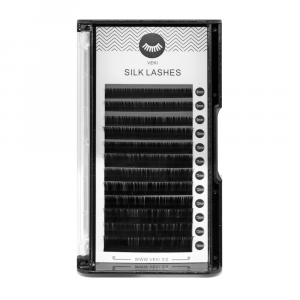
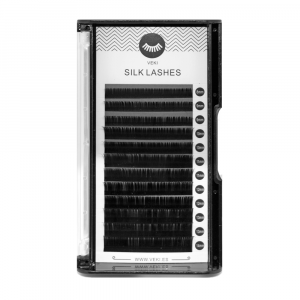
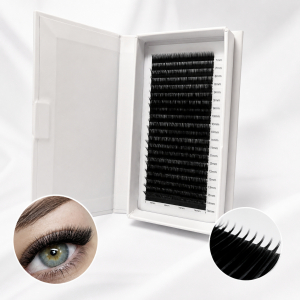
VEKI lash extensions in L, LC and M curl
- VEKI Silk Eyelash Extensions 0.07 L Curl and VEKI Matte Black 0.07 L
- VEKI Eyelashes 0.07 LC Curl
- VEKI Matte Black Eyelash Extensions 0.07 M
- 20-row trays: 0.07 L, 0.07 LC and 0.07 M
For the inner corner or transitions, combine them with VEKI Glossy Black 0.07 D. You will find every curl in volume eyelash extensions.
FAQ
Can I use L curl for classic lashes?
Yes. It works for classic and volume sets; just match thickness and length to the natural lash.
What is the difference between L and LC?
Both have a flat base. The L lifts with a sharper bend; the LC ends in a softer C curve.
Does M curl lift more than D?
It lifts more from the base thanks to the flat part, but its curve is rounder than an L.
Do L curls have worse retention?
Not necessarily. Attached properly along the flat base, retention is similar to other curls; it depends mainly on prep, glue and humidity in the room.
Related products


VEKI silk-effect lashes 0.07 LC curl: straight base and a C-like tip for straight or downward lashes. 12-row tray, 7–14 mm or Mix.
- On sale!