

- 32320 views

Does hypoallergenic eyelash extension glue exist?
No eyelash extension adhesive is 100% hypoallergenic. All professional lash glues are based on cyanoacrylate, and any client can become sensitised to it. A "hypoallergenic" label only means the manufacturer has tried to reduce the risk, not that a reaction is impossible.
What does "hypoallergenic" mean on a label?
In the EU, any claim on a cosmetic, including "hypoallergenic", must be supported by evidence. Many manufacturers use the HRIPT (Human Repeat Insult Patch Test), a repeated patch test on volunteers carried out under dermatological supervision to check for irritation or allergic reactions on the skin. A good result shows that the formula minimises the risk, but it does not make the product suitable for everyone.
People have different levels of sensitivity. The same ingredient may cause nothing in one client, mild itching in another and a full allergic reaction in a third. The word "hypoallergenic" is also sometimes used simply as marketing. In a study carried out in Brazil, doctors found that 93% of 254 children's products labelled as hypoallergenic contained at least one ingredient that could cause an allergic reaction [1].
Anyone who suspects an allergy should see their doctor or an allergist to find out which ingredients to avoid.
How to read an ingredient list
Ingredients are listed in descending order of quantity: the first ingredient is the one present in the largest amount. Chemical names can look alarming but are usually harmless. People with dermatitis or known allergies should learn the names of the ingredients they react to and check every label.
What is in eyelash extension glue?
Cyanoacrylate: the fast-curing base
Cyanoacrylate gives lash glue its fast curing. It is what allows the adhesive to set in seconds and hold extensions for weeks. It is the main ingredient of every professional eyelash extension glue.
Is there a lash glue without cyanoacrylate?
No. All eyelash extension glues on the market contain a cyanoacrylate. Some "sensitive" glues use a milder type, such as alkoxyethyl cyanoacrylate, which releases fewer fumes. Glues sold online as "cyanoacrylate-free" still contain other acrylates. Anyone allergic to acrylates should avoid eyelash extensions.
PMMA: strength and flexibility
PMMA (polymethyl methacrylate) is added to reinforce the bond. Together, cyanoacrylate and PMMA give lash glue its key properties:
- Fast drying.
- Instant adhesion to the lash.
- Strong, long-lasting retention.
Carbon black: the colour
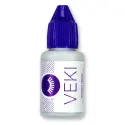
Carbon black gives black lash glue its deep colour. It is only used in black adhesives, so a clear glue is a good option for clients who react to carbon black or who want coloured extensions, for example VEKI Diamond clear eyelash extension glue.
How to reduce the risk of reactions
- Ask about previous reactions before every first appointment.
- Work with the client's eyes fully closed and keep glue away from the skin.
- Ventilate the treatment room and change the glue drop often.
- Use the minimum amount of adhesive needed.
- If a client shows redness, itching or swelling, do not diagnose: recommend professional removal and, if needed, a healthcare professional.
Read more in is cyanoacrylate lash glue safe? and browse our eyelash extension adhesives.
Conclusions
Lash glue ingredients vary from one product to another, so always check them. Before buying, ask the supplier for the safety data sheet and proof that the product has been notified on the EU Cosmetic Products Notification Portal (CPNP).
Source:
[1] Rosana Lazzarini, Mayara Gomes Rangel, Mariana de Figueiredo Silva Hafner, et al. Evaluation of the presence of allergens in children’s products available for sale in a big city, Anais Brasileiros de Dermatologia, Vol. 93, Issue 3, pp. 457-459 (May 2018).
anaisdedermatologia.org.br
Related products


Clear lash extension adhesive without carbon black, 1-2 second drying. Ideal for coloured lashes and lash art.


Three bottles of VEKI Diamond clear eyelash extension glue for the price of two. No carbon black, 1–2 second drying, ideal for coloured lashes.
- -€23.70
- On sale!
- -€23.70


3-for-2 pack of VEKI Premium 1-second black lash glue. For experienced lash technicians working at 40–60% humidity.
- -€25.75
- On sale!
- -€25.75


Fast black lash extension adhesive: 1 second drying for classic and Russian volume 2D-6D. Best at 18-24 °C and 40-60% humidity.


Three bottles of VEKI Profi black eyelash extension glue for the price of two. 1–2 second drying, 20–70% humidity, for Classic and Russian Volume.
- -€23.70
- On sale!
- -€23.70


Black lash extension adhesive with 1-2 second drying, for classic and Russian volume. Works at 20-70% humidity and 18-24 °C.